

Let’s be real: traditional ad creation used to be a long, tedious process. You’d brainstorm, design, write, edit, test, and wait, often for weeks. It was creative, sure, but it was also slow and expensive.
Now, things look very different. With AI ad maker, brands can generate, test, and optimize ad creatives in minutes instead of days. These tools use artificial intelligence to automate much of the creative process, saving time, cutting costs, and scaling output effortlessly.
Whether you’re a new startup or a global brand managing dozens of campaigns, AI-powered creative production is rewriting the marketing playbook.
What Is the Full Funnel Approach?
Before diving into how AI fits in, it’s important to understand what marketers mean by the “full funnel.”
A full-funnel strategy covers the entire customer journey, from awareness to loyalty, ensuring your ads are relevant at every step. The four main stages are:
- Awareness: When customers first discover your brand.
- Consideration: When they start comparing you with other options.
- Conversion: When they decide to buy.
- Loyalty: When they return and recommend your brand to others.
The role of AI ad maker is to craft customized content for each stage. By tailoring messages and visuals based on where a customer is in their journey, AI makes ads feel personal, timely, and relevant.
How AI Ad Makers Work
Here’s a simple breakdown of how AI tools transform the creative process from concept to campaign.
- Input Gathering:
You start by feeding the system details such as audience demographics, product features, tone of voice, and preferred ad platforms. Think of it as giving your AI ad maker a creative brief.
- Template Selection:
The AI suggests templates suited for your campaign goals and platforms, for example, a short video ad for Instagram or a carousel for Facebook.
- Creative Generation:
Using your inputs, the AI ad generator creates multiple ad variations, writing copy, designing visuals, and even producing short videos that match your brand’s tone.
- Optimization:
Once the campaign is live, the AI monitors engagement and conversion data. It automatically refines ad elements like headlines, visuals, and CTAs for better performance.
This cycle continues, creating a constant loop of improvement, faster, smarter, and data-driven.
How AI Powers Full-Funnel Creative Production
Let’s look at how AI supports each stage of the marketing funnel.
1. Top-of-Funnel: Creating Awareness
This stage is all about getting noticed. You want your brand to stand out in crowded feeds and capture attention instantly.
What AI can do:
- Generate eye-catching visuals and short-form videos for platforms like Instagram Reels, TikTok, and YouTube Shorts.
- Test multiple hooks and captions simultaneously to see what drives clicks.
- Automatically adjust messaging based on audience segments or engagement history.
AI makes brand discovery faster, more efficient, and more consistent across channels.
2. Mid-Funnel: Building Consideration
Once people are aware of your brand, they need reasons to care. Here, personalization becomes key, and this is where AI truly shines.
What AI can do:
- Create retargeting ads for users who viewed your products but didn’t purchase.
- Produce dynamic visuals showing recently viewed items or customer testimonials.
- Personalize messaging for different buyer personas (e.g., value-seekers vs. trend-followers).
As marketing strategist Jane Doe puts it, “The more personal your content feels, the better it performs. AI helps make that personalization possible at scale.”
3. Bottom-of-Funnel: Driving Conversions
At this stage, your goal is to get the customer to act, whether that means signing up, subscribing, or buying.
What AI can do:
- Generate high-converting ads with powerful CTAs like “Shop Now” or “Claim Your Discount.”
- Test different versions of headlines, product visuals, and price placements to identify what converts best.
- Use behavioral data to time promotions when users are most likely to engage.
Pro Tip: AI excels at testing and refining, but humans still need to ensure the message aligns with the brand promise and tone.
4. Post-Purchase: Nurturing Loyalty
The funnel doesn’t end after checkout. Retaining customers is cheaper and more profitable than constantly acquiring new ones, and AI can help here too.
What AI can do:
- Automate thank-you messages, referral incentives, or re-engagement campaigns.
- Use purchase history to generate personalized upsell or cross-sell ads.
- Recommend content that deepens brand connection, like tutorials or product tips.
Quick Tip: Automation keeps your brand top-of-mind without overwhelming your team.
Advantages of AI in Creative Production
Speed
AI ad makers can produce multiple creative versions in minutes. This speed gives marketers room to experiment, test, and optimize in real time, no waiting for long production cycles.
Scalability
AI makes scaling campaigns effortless. You can generate thousands of ad variations across different audience groups or geographies without expanding your creative team.
Consistency
Once your brand kit is uploaded, AI maintains tone, color palette, and logo placement automatically, ensuring every creative feels on-brand.
Cost-Effectiveness
By automating repetitive design and copywriting tasks, AI reduces dependency on large creative teams. The savings can be reinvested into strategy, testing, or media spend.
Workflow Integration
AI tools integrate seamlessly with marketing platforms and collaboration systems.
- Marketers focus on strategy and insights.
- Designers refine AI-generated visuals to match aesthetics.
- Compliance teams review ads for legal accuracy.
Everyone stays aligned, and creative bottlenecks disappear.
Best Practices to Maximize AI Ad Maker Results
- Provide Clear, High-Quality Inputs
The more detailed your brief, the better the AI performs. Specify audience type, tone, key benefits, and must-have visual elements.
- Keep Briefs Updated
As your brand evolves, refresh your guidelines and examples so AI always produces content that reflects your latest identity.
- Use Performance Data for Iteration
Don’t just rely on AI outputs. Review performance analytics regularly to identify what resonates most with your audience and fine-tune future prompts.
Real-World Example: Brand X’s AI-Powered Funnel
Take Brand X, a D2C skincare label. They adopted an AI ad generator to manage their full-funnel campaigns, from awareness videos to post-purchase follow-ups.
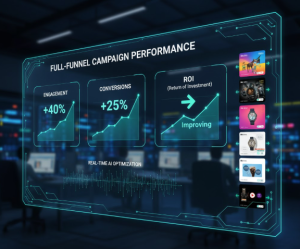
Results after 3 months:
- Engagement: 40% increase in ad interactions.
- Conversion Rate: 25% more purchases.
- ROI: Significant improvement in ad spend efficiency.
Their CEO summed it up perfectly:
“We’ve seen a huge boost in ROI since we moved to AI-driven creative production. The time we’ve saved is just as valuable as the results.”
Conclusion
The AI ad maker is transforming creative production from a time-consuming process into a scalable, data-driven system. From generating awareness to building loyalty, AI supports marketers at every stage of the funnel with speed, precision, and personalization.
But while AI can automate creative execution, human expertise still defines the strategy, storytelling, and emotion behind successful campaigns.
The winning formula is simple: let AI handle the scale, and let humans handle the soul. Together, they turn marketing into a continuous loop of creativity, performance, and growth.